

How do UV water systems work
How Do UV Water Systems Work
Installing a UV water filter is an increasingly popular choice for households across the UK who are looking for a reliable, chemical free way to improve water safety.
Unlike traditional filters that eliminate contaminants, ultraviolet water filters neutralise harmful microorganisms on a microscopic scale.
These systems are particularly beneficial in contexts where bacterial or viral contamination is a concern, including private water supplies, aging plumbing infrastructure, or storage tanks.
This guide explains UV water systems and helps you determine if they suit your current filtration needs.
Key Points
- UV water filters neutralise bacteria, viruses, and protozoa by disrupting their DNA, they don't remove them.
- They can achieve up to 99.99% reduction in biological contaminants under ideal conditions.
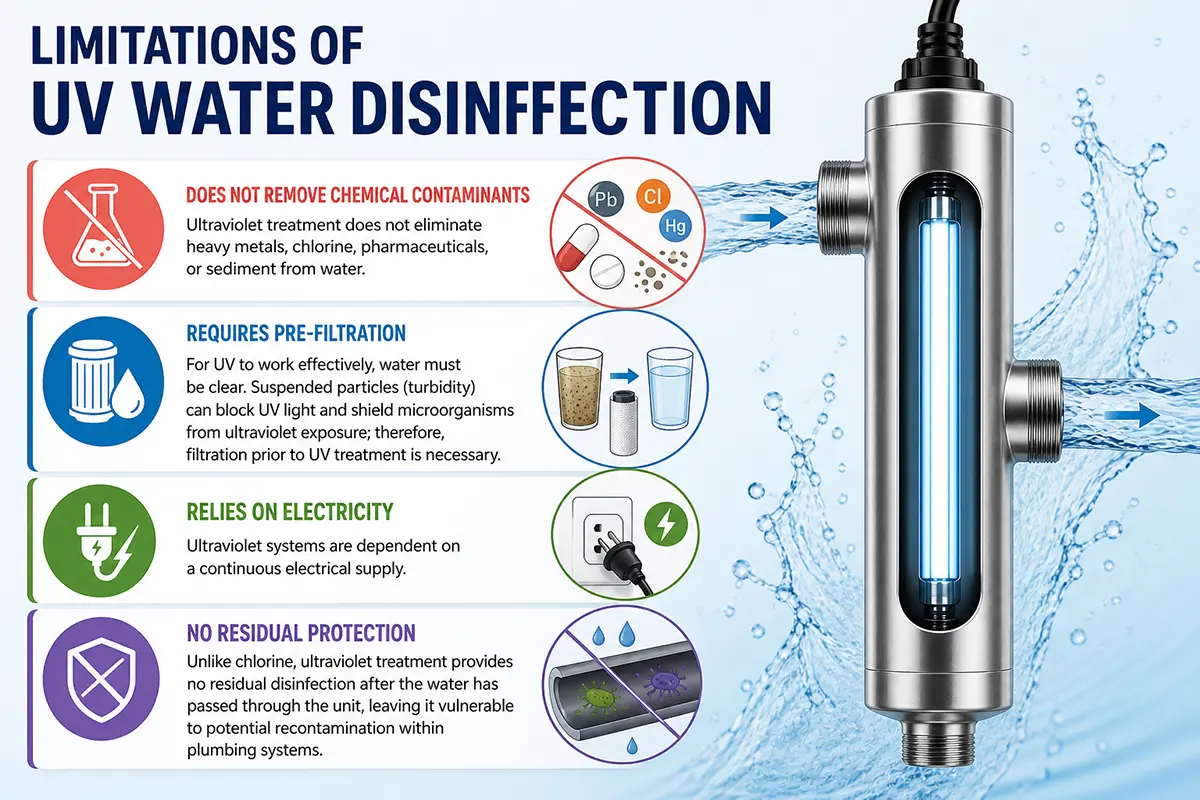
- UV systems do not remove chemicals, heavy metals, chlorine, or sediment. Pre-filtration is essential.
- Most UK homes on mains water don't need a UV system. They're mainly for private water supplies (wells, boreholes).
- UV lamps need replacing every 12 months to stay effective.
- Always pair a UV system with a sediment pre-filter for best results.
Table of contents
- How UV light purifies water (the simple explanation)
- Do UV water filters work?
- How a UV water system works step by step
- Do you need a UV water system in the UK
- UV water filter vs other filtration systems
- Pros and cons of UV water systems
- How to choose the right UV system
- Maintenance and running costs
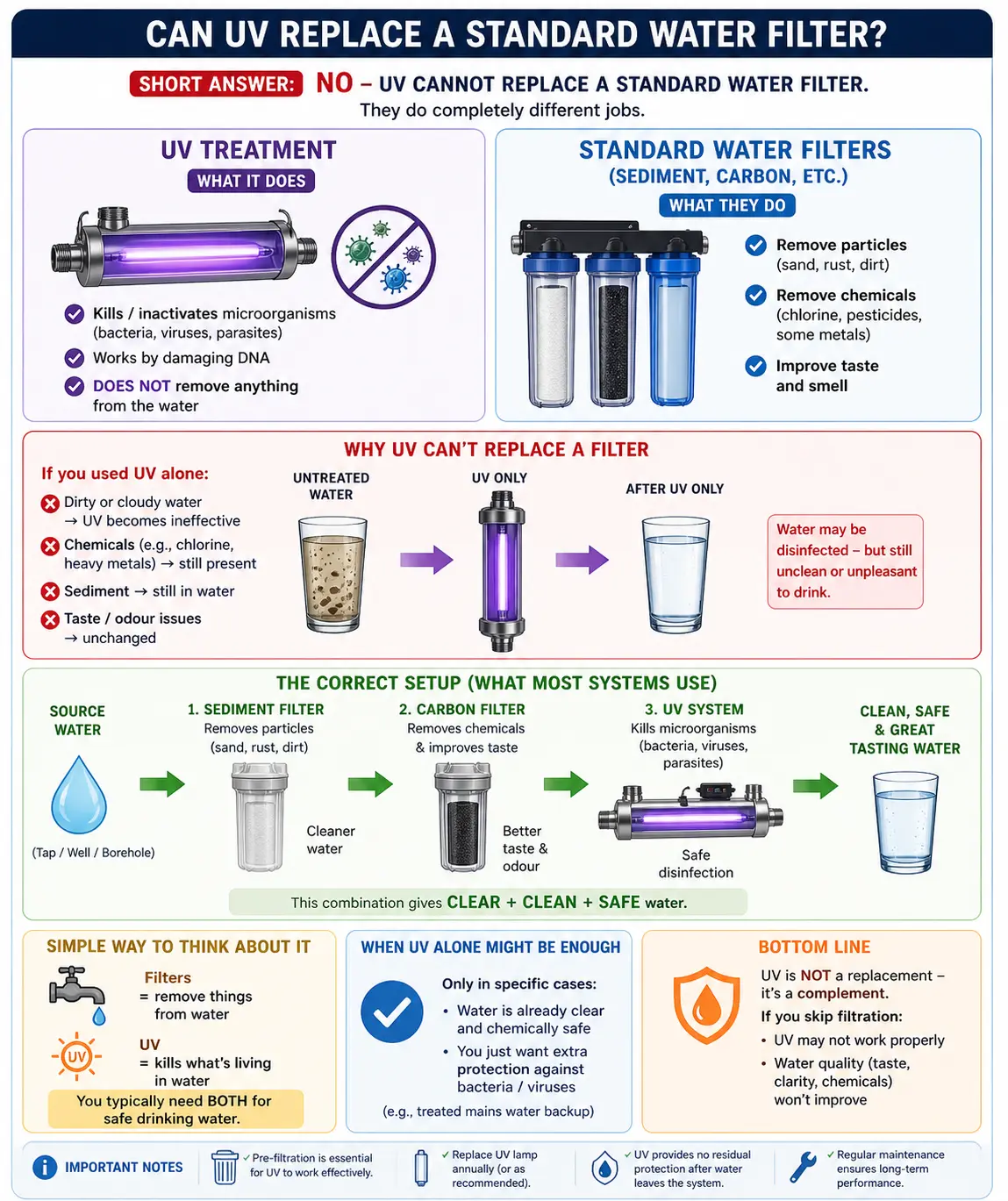
- Can UV replace a standard water filter
- When UV is the right solution
- FAQs
How UV light purifies water (The simple explanation)
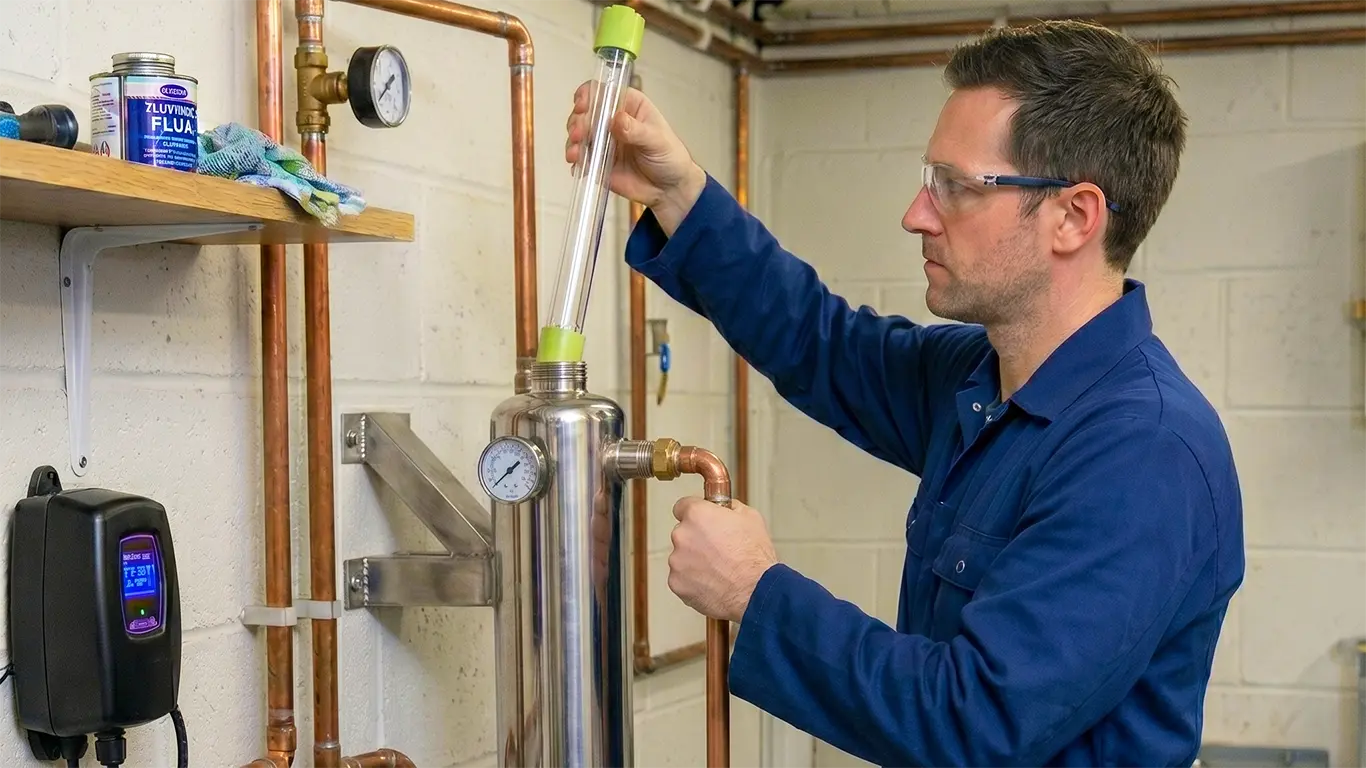
A UV water filter works through a simple but highly effective process. As water flows through a stainless steel chamber, it passes a UV lamp housed inside a protective quartz sleeve. This lamp emits ultraviolet light at a precise wavelength; typically, around 254 nanometres, which is especially powerful against harmful microorganisms.
When the water moves past the lamp, the UV light penetrates bacteria, viruses, and protozoa present in the water. Instead of physically removing these contaminants, a UV water filter neutralises them by disrupting their DNA. This prevents them from reproducing or causing infection, making the water safe to use.
What happens to bacteria and viruses under UV light
UV light kills bacteria and viruses by deactivating them.
Bacteria and viruses in water lack the protective barrier that human cells have, making them susceptible to the intense energy of UV rays.
- Ultraviolet (UV) energy penetrates the outer cellular wall or viral protein coat and is subsequently absorbed by nucleic acids; DNA in bacteria and either DNA or RNA in viruses.
- The genetic strands may break or become joined together.
- The organism can no longer replicate.
Because microorganisms rely on reproduction to spread infection, this effectively renders them harmless.
Organisms stay in the water but become inactive, so UV is considered a disinfection method, not a filtration method.
Do UV water filters work?
A properly installed and maintained ultraviolet (UV) water filtration system is considered one of the most efficient methods for water disinfection. Ultraviolet water filter systems, used with pre-filtration, are found in homes (normally on a private water supply), hospitals, labs, and UK water treatment plants.
Independent UK research and Drinking Water Inspectorate guidance support that properly designed UV-C disinfection systems can achieve up to 99.99% (4-log) reduction of bacteria, viruses, and protozoa under validated operating conditions.
What UV systems are proven to remove
UV water filters are highly effective against a wide range of biological contaminants, including:
- Bacteria such as E. coli, Salmonella, Streptococcus, Coliform bacteria, Legionella, Pseudomonas aeruginosa
- Viruses such as Norovirus, Hepatitis A, Polio, SARS-CoV-2, Influenza, Rotavirus.
- Protozoan (chlorine resistant) cysts like Giardia and Cryptosporidium.
- Other microbes such as mould, algae, fungi, and parasites.
What UV systems cannot remove
Although UV systems work well, they still have some drawbacks. Specifically, they are unable to remove:
- Sediment and particulates – dirt, rust, sand, and other suspended solids. These can all shield bacteria from the UV light. It’s important to have pre-filtration in place before water passes through the UV water filter.
- Dissolved chemicals – pesticides, herbicides, pharmaceuticals, industrial chemicals.
- Heavy metals – lead, arsenic, mercury, iron, manganese, or salts.
- Chlorine and Chloramines – UV light can break down but not remove chlorine or chloramine. Chlorine impacts the taste and smell of your water, but it’s highly unlikely that you’d have chlorine in your water if you’re on a private water supply.
- Volatile organic compounds (VOCs) – an ultraviolet water filter system will not remove these.
- Taste, smell, and colour of water – because UV doesn’t remove dissolved solids or chemicals, it does not improve the taste or smell of water.
Fountain Filters expert advice: ''A UV water filter should always be paired with appropriate pre-filtration or additional treatment methods.''
| Contaminant Type | Removed by UV? | Notes |
| Bacteria, (E. coli, Salmonella, Legionella) | Yes | DNA disruption renders them inactive |
| Viruses (Norovirus, Hepatitis A, Rotavirus) | Yes | Highly effective |
| Protozoa (Giardia, Cryptosporidium) | Yes | Chlorine-resistant: UV is particularly effective here |
| Sediment, rust, dirt | No | Requires sediment pre-filter |
| Chlorine/chloramines | No | Use activated carbon for this |
| Heavy metals (lead, arsenic, iron) | No | Requires reverse osmosis |
| Pesticides / herbicides | No | Requires activated carbon or RO |
| VOCs | No | Requires specialist filtration |
| Taste, smell, and colour | No | Not a filtration method |
| Limescale / hard water minerals | No | Requires water conditioner / water softener |
How a UV water system works step by step
It’s been established that ultraviolet water filter systems eliminate microorganisms in water using germicidal ultraviolet light, protecting humans from possible harm.
Below is a detailed explanation of how these microorganisms are removed.
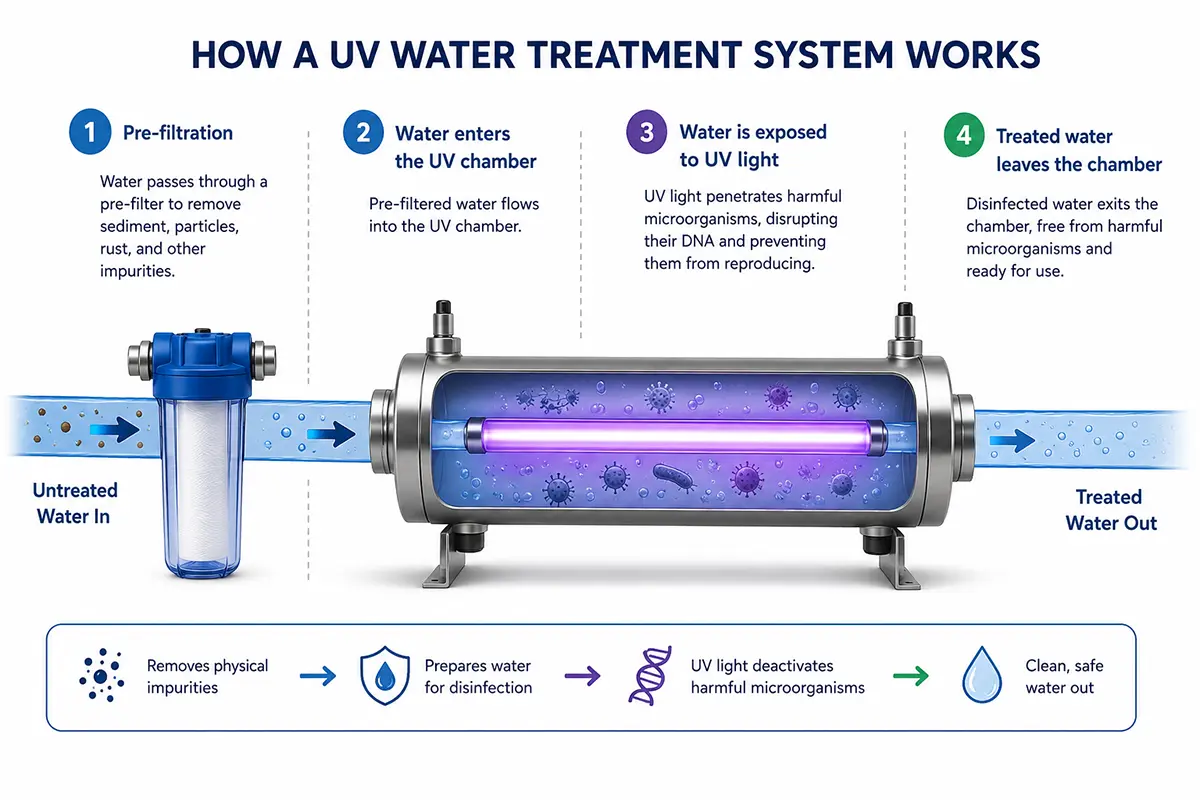
Step 1 - Pre-filtration
For UV light to penetrate effectively you must remove any particles, dirt, rust, and turbidity from the water.
This is achieved by ensuring the water passes through a pre-filter containing a pleated sediment cartridge with a 5 or 20 micron rating; or a configuration of the two.
This step is crucial because particles in the water can shield microorganisms from UV light, reducing the system’s effectiveness.
Step 2 – Water enters the UV chamber
Following pre-filtration treatment, the water passes into a chamber constructed of stainless steel or plastic, commonly known as the reactor. The water moves through the area between the quartz sleeve and the chamber wall, while the UV lamp is positioned within the protective quartz sleeve.
Stainless steel chambers tolerate higher temperatures. If water isn't flowing when the power is on, it can heat up. Plastic chambers are more vulnerable to heat damage.
Let’s look at what’s happening to the water as it flows through the chamber and gets a sufficient dose of UV radiation.
Step 3 – Water is exposed to UV light
The UV lamp housed inside the quartz sleeve releases intense UVC light. The sleeve allows the ultraviolet rays to shine through but keeps the lamp dry.
As this UV radiation penetrates microorganisms’ cell membranes, it disrupts their DNA and RNA. Ultimately, this process prevents these microorganisms from multiplying or causing disease.
Step 4 – Treated water leaves the chamber
After the UV light has effectively purified the water, the treated and potable water exits the chamber and proceeds through the pipework to the tap.
Flow rate and exposure time
For UV disinfection to work properly, water must receive a sufficient “dose” of UV light.
This depends on:
- The intensity of the lamp
- The clarity of the water
- The speed at which water flows through the system
A dose of UV radiation is typically measured in millijoules per square centimetre (mJ/cm²), representing the product of the lamp's intensity and the water's residence time within the reactor.
If water flows too quickly, microorganisms may not receive enough exposure. That’s why systems are carefully rated for specific flow rates and household sizes.
Do you need a UV water system in the UK
Most households in the UK do not need a UV water filter system.
If your home is on mains water you’re already benefitting from treated water which makes it safe to drink and cook with. Water treatment plants use a disinfectant called chlorine to kill harmful contaminants from tap water.
Installing a UV water filter is recommended if your water hasn’t already been treated. For example:
- You have a private water supply (well, borehole, spring, stream)
- You store water in tanks where contamination is possible.
- You’ve had bacteria issues such as E. coli, and coliforms.
UV water filter vs other filtration systems
Different water filtration methods do different jobs and solve different problems. It’s not a like for like comparison or a one size fits all when it comes to filtering water as each method complements another.
Let’s look at the main water filtration methods and what they do and don’t remove.
| Contaminant | UV System | Reverse Osmosis (RO) | Carbon Filter | Sediment Filter |
| Bacteria & Viruses |
? |
X (not reliable alone) |
X |
X |
|
Parasites (Giardia, Cryptosporidium) |
? |
X (not reliable alone) |
X |
X |
|
Chlorine (common in UK mains water) |
X |
? |
? |
X |
|
Bad taste/smell |
X |
? |
? |
X /? (slight) |
|
Heavy Metals (lead, copper) |
X |
? |
X /? (limited) |
X |
|
Fluoride |
X |
? |
X |
X |
|
PFAS |
X |
? |
X /? (some reduction) |
X |
|
Limescale (hard water areas) |
X |
X /? reduces |
X |
X |
|
Sediment (rust / dirt) |
X |
? |
? (fine) |
? (main job) |
|
Microplastics |
X |
? |
? (some) |
X /? (some) |
|
Chemicals / Pesticides |
X |
? |
? (some) |
X |
|
Best for |
Private water supplies or extra protection from bacteria |
Ultra clean drinking water |
Everyday tap water improvement |
As a pre-filter and/or protecting other systems |
A very simple way to think about it is:
- UV – kills germs only
- RO – removes almost everything
- Carbon – improves taste and removes chlorine
- Sediment – removes visible particles
Effective water treatment typically integrates multiple methods for optimal results.
Pros and cons of UV water systems
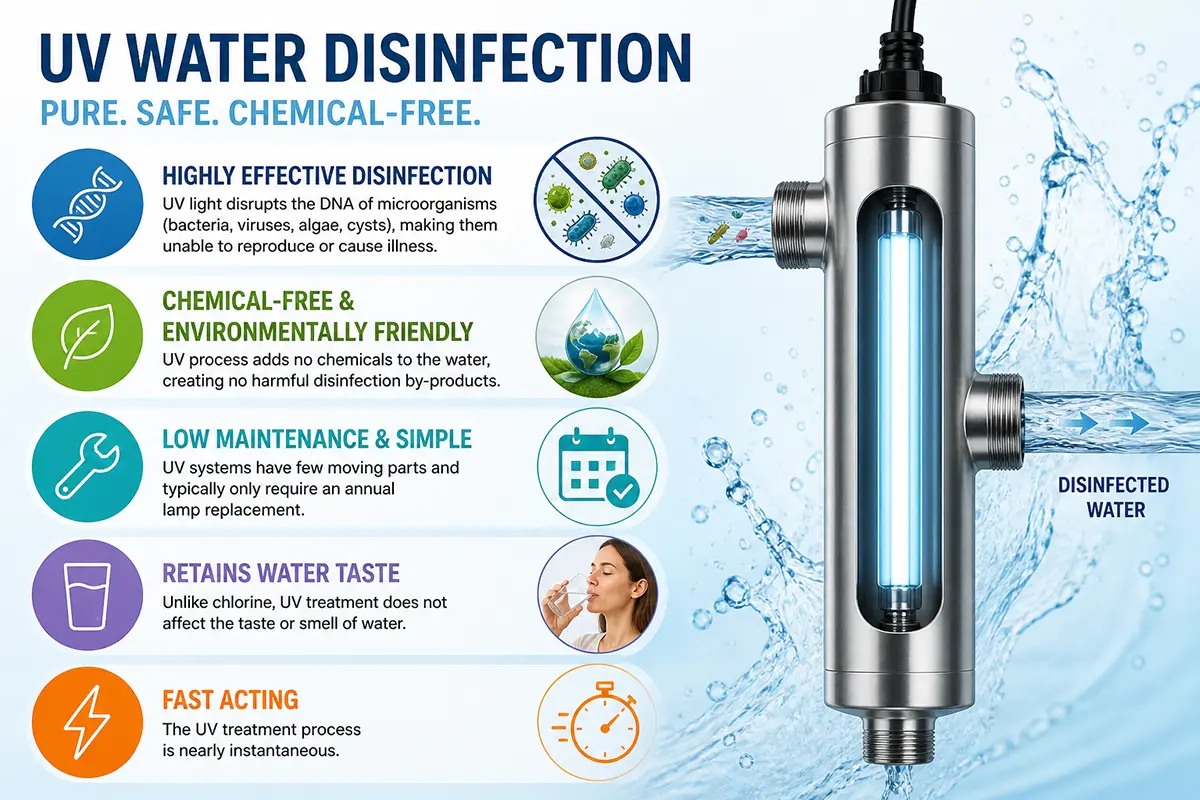
UV water filters provide a dependable way to disinfect water without chemicals, requiring minimal upkeep, and effectively protecting against bacteria, viruses, and cysts.
As with any water filtration system there are pros and cons:
| Theme | Pro | Con |
| Disinfection | Up to 99.99% effective against bacteria, viruses, and protozoa, including chlorine-resistant Giardia and Cryptosporidium. | Does not remove chemicals, heavy metals, or dissolved solids. |
| Chemical-free | Nothing is added to your water. No chlorine, no by-products, no taste impact. | Cannot remove existing chemicals, pesticides, or VOCs already in the water. |
| Water quality | Preserves natural minerals and does not affect taste or smell. | Less effective is water clarity is poor, turbidity blocks UV light. |
| Maintenance | Low running costs, comparable to a small household appliance. | Annual lamp replacement is non-negotiable, not optional. |
| Safety | Environmentally friendly, no chemical waste or py-products. | No visible warning if the lamp fails, an alarm is recommended. |
| Installation | Compact and straightforward to install. | Must be paired with a sediment pre-filter to work effectively. |
| Cost | Long-term value with minimal consumable beyond the annual lamp change. | Upfront cost higher than a basic filter alone. |
| Power | Designed for continuous 24/7 operation with minimal energy use. | Requires a constant electricity supply, no power means no protection. |
Pros of UV water systems
Cons of UV water systems
How to choose the right UV system
Selecting a UV water filter is about finding the best fit for your water quality, flow rate, and needs.
Consider these essential factors.
Flow rate and household size
Flow rate determines how much water the ultraviolet water filter system can effectively treat.
- Small use (tap / single point): 12 l/pm or 22 l/pm Treats water at a single tap, usually for drinking and cooking.
- Whole house (typical UK home): 41 l/pm or 57 l/pm Treats all water entering the property, including showers and appliances.
- Larger homes / commercial: 79 l/pm
UV dose (disinfection strength)
The minimum dose of UV required for disinfection depends on several factors, including the susceptibility of microorganisms but is generally taken to be around +/- 40mJ/cm2.
The clarity of water is usually expressed in terms of the amount of UV light that can pass – its ‘Ultraviolet Transmittance’ (UVT). Minimum UVT values, typically greater than 90-95%, are commonly specified by UV equipment manufacturers/suppliers.
Water quality
We’ve already touched on pre-filtration, but UV only works on clear water.
This means your water should be clear of particles, dirt, rust, and turbidity.
Any turbidity in your water supply will block the UV light and reduce its effectiveness.
Pre-filtration is a critical step for households on a private water supply.
Installation location
The type of UV system you choose will be determined by where you’re going to install it.
| Application | Best system type |
|
Kitchen tap |
Point of use (small UV system) |
|
Whole house |
Inline UV system |
|
Outdoor / travel |
Portable UV device |
|
Private water supply |
High output + pre-filtration |
Build quality and features
Before purchasing a UV water filter system, it's essential to research your options. Choose a UV system with stainless steel construction, as these models handle higher temperatures effectively. If the water stops flowing while powered on, it may become hot. Systems made with plastic chambers are more susceptible to heat damage.
Having a UV lamp failure alarm is helpful, as it notifies you when it's time to replace the UV lamp.
Maintenance and running costs
Looking after a UV water filter is simple, but it's important to replace the UV lamp on schedule. Changing the lamp regularly helps keep the water disinfection process effective.
Running costs are generally low, with electricity usage comparable to a small household appliance. A typical UV system is designed for continuous operation. Most systems run 24/7 so 1 year is equal to 8,760 hours of runtime. That’s the rated lifespan for maintaining effective UV output, not total lamp failure.
A typical maintenance schedule would look like this.
- Replace the UV lamp - it is recommended to replace the UV lamp at least every 12 months. This is not due to typical bulb burnout, but rather because the lamp gradually loses its effectiveness in disinfecting water. Although the lamp may continue to emit light, its UV-C intensity; the aspect responsible for eliminating germs diminishes over time.
- It is advisable to replace the quartz sleeve every few years. Over time, minerals and deposits may accumulate on the quartz sleeve that encloses the UV lamp, reducing its effectiveness by blocking UV light from penetrating the water. This issue is especially prevalent in areas with hard water.
- If your system includes pre-filtration, be sure to replace the sediment filters every 6 to 12 months. Keep in mind that a UV water filter operates most efficiently when the water is clear.
It is important to prioritise safety over visibility. Unlike filters that may become blocked or chlorine which emits a detectable odour, a malfunctioning UV lamp provides no visible indication of failure. Without an alarm system installed on the unit, there are no clear warnings when disinfection is insufficient.
So, annual replacement is a preventive safety measure.
Can UV replace a standard water filter
The following diagram shows why a UV water filter can’t replace a standard filter.
When UV is the right solution
A UV water filter is the right choice:
- When your primary concern is microbiological contamination.
- If you’re drawing water from a well, borehole, or any other untreated water source.
- The water is already clear and pre-filtered.
- You want a chemical free disinfection method.
- You have a reliable electricity supply.
- You need whole house protection.
- You want a low maintenance system.
When used as part of a properly designed system, a UV water filter provides a powerful and reliable final barrier, helping ensure your water is not just clear, but truly safe to drink.
Further reading:
- Guidance on the use of ultraviolet (UV) irradiation for the disinfection of public water supplies
- Decontamination Potential of Ultraviolet Type C Radiation in Water Treatment Systems: Targeting Microbial Inactivation
FAQs
Do UV water filters kill all bacteria and viruses
UV systems disable bacteria, viruses, and protozoa by damaging their DNA, but do not remove them from water. Effectiveness relies on proper dose, flow rate, and water clarity.
Does UV water filtration remove chlorine or chemicals
UV treatment disinfects but does not remove chlorine, heavy metals, pesticides, or chemicals. For chemical removal, UV is typically combined with activated carbon or other filters.
Do I need a UV filter if I have mains water in the UK
Mains water in the UK is generally safe to drink without a UV system, but some people use one for extra assurance, especially with private sources or older plumbing.
How often does a UV lamp need replacing
Replace UV lamps annually to maintain effective disinfection, as their performance declines over time even if they still function.
Can UV water systems work with hard water
UV systems can treat hard water, but scale on the quartz sleeve lowers effectiveness. Regular cleaning or using a pre-filter or water softener maintains performance.
Is UV water treatment safe for drinking water
UV treatment is a safe, popular method for disinfecting drinking water. It adds no chemicals or taste, provided the system is installed and maintained correctly.
About the author

Louise Allen is a partner at Fountain Filters, where she's helped run the business since 2011. Alongside the day-to-day order management, despatch, and quality, she's built up a practical, hands-on knowledge of water filtration, and reviews the site's articles to keep the advice accurate and genuinely useful. Outside work, she's run the London Marathon with business partner Simon.
