

How to filter microplastics from drinking water
How to Filter Microplastics from Drinking Water
Microplastics in drinking water have attracted increasing attention in recent years. They have been detected in both tap water and bottled water, and improvements in scientific testing mean researchers can now detect particles that were previously difficult or impossible to measure.
But there is a lot of conflicting information online about microplastics. Some claims are alarming, while others oversimplify the problem.
The reality is more interesting.
Microplastics are physical particles, which means they can be separated from water by suitable filtration. But not all water filters will remove the same size particles, and choosing a filter based simply on the smallest number of microns you can find isn't necessarily the right approach.
In this guide, we'll look at the latest research into microplastics in drinking water, including UK tap water and bottled water, what we know about potential health effects and, most importantly, how filtration works.
Key Points
- Microplastics have been detected in all UK tap water and bottled water samples tested by a 2025 study, averaging around 40 particles per litre in tap water and 37 in bottled water - not a statistically significant difference.
- Detecting microplastics doesn't mean UK tap water is unsafe: it's extensively treated and regulated, and there's currently no universally accepted regulatory limit for microplastics specifically.
- The WHO has reviewed the evidence and found significant gaps in understanding; based on what's known so far, microplastics in drinking water don't appear to pose a significant health risk at current levels, though more research - especially into nano-plastics - is needed.
- Microplastics span a huge range of sizes, so a filter's micron rating only protects against particles larger than that rating - no single filter removes every microplastic.
- Point of use filters vary in effectiveness: research found membrane filtration performed better at removing microplastics than granular activated carbon and ion exchange alone.
- Boiling hard water can trap some microplastics in the resulting limescale, but it doesn't destroy the plastic and isn't a reliable substitute for proper filtration.
Table of contents
- What are microplastics?
- Are there microplastics in tap water in the UK?
- Tap water vs bottled water: which contains more microplastics?
- Are microplastics in drinking water harmful?
- Can microplastics be removed from water?
- What about boiling water?
- How to filter microplastics from drinking water
- What is the best water filter to remove microplastics?
- FAQs
- Need help choosing a water filter?
What are microplastics?
Microplastics are small pieces of plastic generally defined as particles less than 5 millimetres in size.
That definition covers an enormous range of particle sizes. A 4 mm fragment and a particle measuring just a few micrometres can both be classified as microplastics, even though they behave very differently in water and present very different filtration challenges.
Microplastics can be created deliberately at small sizes, but many are produced when larger plastic items break down. Sunlight, weathering, abrasion and physical wear can gradually break plastic products down into smaller particles.
They can take several forms, including fragments, fibres, films and small pellets.
The plastic itself can also vary. Researchers have identified polymers such as polyethylene (PE), polypropylene (PP), polyethylene terephthalate (PET) and other plastics in water samples.
There is another important distinction between microplastics and nano-plastics. Nano-plastics are generally understood to be particles smaller than 1 micrometre, although definitions and measurement methods vary between studies.
Why does this matter when we're talking about water filtration?
Because particle size is fundamental to filtration.
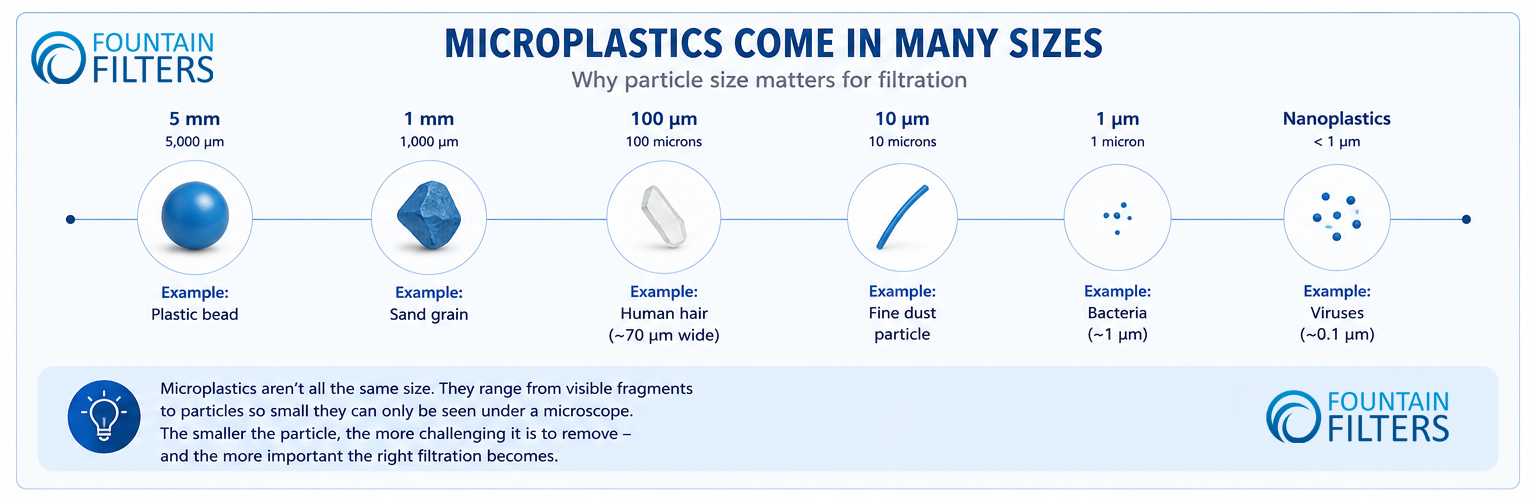
A filter doesn't know whether a particle is microplastic. It simply provides a physical barrier. Whether a particular particle is retained depends on its size, shape and the characteristics of the filtration medium.
Are there microplastics in tap water in the UK?
Yes. Microplastics have been detected in UK tap water.
However, that statement needs some context.
A particularly useful study published in 2025 investigated microplastics in UK drinking water using the same analytical approach for both tap water and bottled water. Researchers tested 177 tap water samples from 13 UK cities and 85 bottled water samples from 17 brands sold in the UK.
Microplastics were detected in all the samples tested.
The average concentration was approximately 40 microplastic particles per litre in tap water. The researchers found considerable variation between individual samples, however, so this should not be interpreted as meaning that every litre of UK tap water contains exactly 40 particles.
The study also looked at the size, shape and polymer composition of the particles rather than simply counting them. The average particle size was approximately 32.4 micrometres in tap water, although particles occurred across a much wider size range.
This is an important point when considering how to filter microplastics from water. Knowing that microplastics are present doesn't tell us what size filter is required.
Does this mean UK tap water is unsafe?
The presence of microplastics does not mean that UK tap water is unsafe to drink.
Public drinking water in the UK is extensively treated and regulated. Microplastics are an emerging area of research, and there is currently no universally accepted regulatory limit for microplastics in drinking water equivalent to the limits established for many other substances.
It is therefore important not to turn the detection of microplastics into a claim that UK drinking water is dangerous.
The more measured conclusion is that microplastics are present, scientists are still investigating their significance, and filtration provides a practical way of reducing particles in drinking water if you want to minimise your exposure.
Research source: Synthetic Microplastics in UK tap and bottled water; Implications for human exposure, Emerging Contaminants, Volume 11, Issue 1, 2025. The study examined 177 UK tap water samples and 85 bottled water samples.
Tap water vs bottled water: which contains more microplastics?
 This is where the story becomes more complicated.
You may have seen claims that bottled water contains hundreds or even hundreds of thousands of plastic particles per litre.
Some of those claims are based on genuine scientific studies, but comparing the numbers from different studies can be misleading because researchers use different sampling and analytical techniques and may be measuring very different particle sizes.
For example, a 2024 study published by researchers from Columbia University and Rutgers University used advanced imaging techniques to investigate much smaller plastic particles, including nano-plastics, in bottled water. The study estimated approximately 240,000 plastic particles per litre across the three bottled water brands tested, with most of those particles being nano-plastics rather than conventional microplastics.
That number should not be directly compared with a study that only measures larger microplastics.
The 2025 UK study provides a much more useful comparison because it examined tap and bottled water using the same methodology.
It found average concentrations of approximately:
- 40 microplastic particles per litre in UK tap water
- 37 microplastic particles per litre in bottled water
The difference was not statistically significant.
Interestingly, the researchers found that the average particle size was larger in tap water samples than in the bottled water samples.
This doesn't mean that bottled water is necessarily better or worse than tap water in every circumstance. It does mean that the simplistic claim that bottled water always contains more microplastics than tap water isn't supported by the latest UK comparison.
There are also potential sources of plastic particles associated with bottled water itself, including packaging and bottle caps.
For someone concerned about bottled water microplastics in the UK, drinking filtered mains water from a reusable bottle is a practical alternative to relying on single use bottled water.
Research sources:
Synthetic Microplastics in UK tap and bottled water; Implications for human exposure, Emerging Contaminants, 2025
Qian et al., Rapid single particle chemical imaging of nanoplastics by SRS microscopy, Proceedings of the National Academy of Sciences, 2024.
Are microplastics in drinking water harmful?
This is probably the question that concerns people most, but it is also the question where we need to be particularly careful about what the evidence tells us.
Microplastics have been detected in drinking water, food and the wider environment. Researchers are investigating whether different particle sizes, shapes and polymer types could have biological effects.
However, there isn't currently enough evidence to say that the levels of microplastics detected in drinking water cause specific health problems in humans.
The World Health Organisation (WHO) reviewed the available evidence on microplastics in drinking water and identified significant gaps in our understanding of both exposure and potential health effects.
The WHO concluded that, based on the limited evidence available at the time, microplastics in drinking water did not appear to pose a significant health risk at current levels. It also stressed that considerably more research is needed, particularly into smaller particles and nano-plastics.
That is an important distinction.
We know microplastics are present. We don't yet know enough to make definitive claims about the long-term health effects of drinking them.
At Fountain Filters, we think it's better to explain that uncertainty honestly rather than use frightening claims to sell water filters.
If you nevertheless want to reduce your exposure to microplastic particles in drinking water, suitable filtration is one practical option.
Research source: World Health Organisation, Microplastics in drinking water, 2019.
Further reading: Other things found in UK tap water.
Can microplastics be removed from water?
This is where understanding the difference between dissolved contaminants and particles becomes important.
Some substances in water are dissolved at a molecular level. Others, such as sediment and microplastic particles, have a physical presence and measurable dimensions.
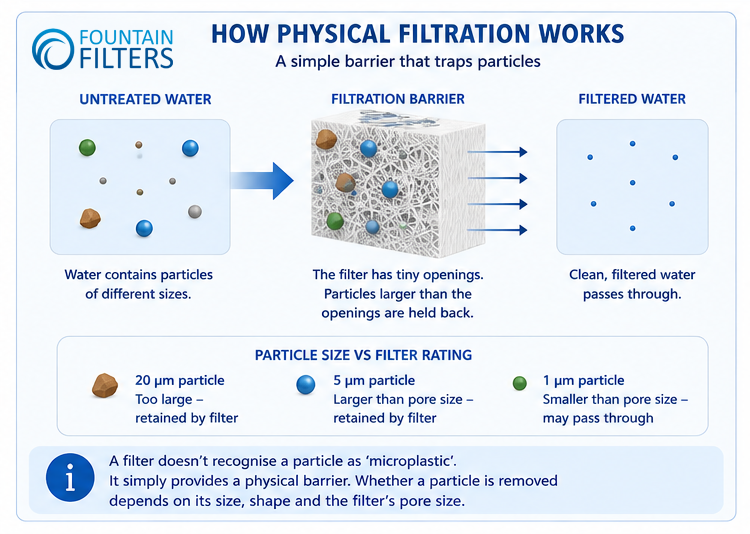
A filter works by providing a barrier through which water can pass while retaining particles that are too large to pass through the filtration medium.
This is the basic principle behind sediment filtration.
If a suspended particle is larger than the effective openings in the filter, the particle can be retained while the water passes through.
That sounds simple, but there is an important complication:
- Microplastics aren't all the same size
This is why the question shouldn't simply be:
- “Does this water filter remove microplastics?”
A better question is:
- “What size particles has this filtration system been designed or tested to retain?”
Research into drinking water treatment supports the principle that physical filtration can substantially reduce microplastics. Conventional drinking water treatment processes can achieve significant removal, although performance depends on the treatment process and the particles being measured.
Point of use filtration can provide an additional barrier immediately before the water is consumed.
A 2023 study specifically examined domestic point of use water filtration systems and found substantial differences between those tested. Devices incorporating membrane filtration performed better at removing the microplastic particles used in the study than the device relying on granular activated carbon and ion exchange alone.
This is a useful reminder that not all water filters are microplastic filters simply because they are called water filters.
Research source: Cherian et al., Microplastic Removal from Drinking Water Using Point of Use Devices, Polymers, 2023, 15(6), 1331. DOI: 10.3390/polym15061331.
What about boiling water?
In 2024, researchers published a study investigating whether boiling tap water could reduce nano and microplastics.
They found that when water containing certain plastic particles was boiled, calcium carbonate could form around the particles in hard water. This caused some of the particles to become incorporated into the resulting limescale.
The researchers found that boiling hard water could remove at least 80% of the tested polystyrene, polyethylene and polypropylene particles between 0.1 and 150 micrometres under their experimental conditions.
However, there is an important qualification.
Boiling does not destroy the plastic.
The particles become associated with calcium carbonate deposits, and filtration is then needed to physically remove the resulting material.
The effect was also strongly influenced by water hardness. The study therefore doesn't mean that simply boiling a kettle of water guarantees removal of microplastics.
It is an interesting piece of research, but for everyday household use, a properly selected filtration system is a much more controlled approach.
Research source: Yu et al., Drinking Boiled Tap Water Reduces Human Intake of Nanoplastics and Microplastics, Environmental Science & Technology Letters, 2024 11(3), 273-279. DOI: 10.1021/acs.estlett.4c00081.
Further reading: Hard water areas.
How to filter microplastics from drinking water
If your objective is to remove microplastics from water, filtration is a logical approach because microplastics are physical particles.
However, the type of filter matters.
Activated carbon is extremely useful in drinking water filtration. It can reduce chlorine and many compounds responsible for unpleasant taste and odour, and some carbon products are designed to reduce some dissolved contaminants.
But activated carbon adsorption and physical particle filtration are two different things.
A carbon filter can contain a carbon block that also provides physical filtration, but you shouldn't assume that a filter removes microplastics simply because it contains activated carbon.
The effective filtration rating matters.
For example, a 10 micron filter cannot be expected to reliably retain particles smaller than 10 microns. Likewise, a 5 micron filter should not automatically be marketed as removing every microplastic particle because some microplastics are considerably smaller.
What size are the microplastics in drinking water?
This is where choosing a microplastic filter becomes more complicated than simply looking for the smallest number of microns.
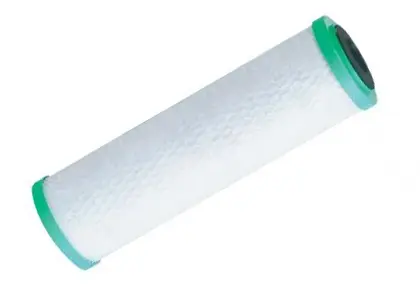
Microplastics range from relatively large particles through to particles approaching the nano-plastic range.
The 2025 UK study found average particle sizes of approximately 32.4 micrometres in tap water and 26.5 micrometres in bottled water, but the particles covered a much wider size range.
Particle shape also matters.
Microplastics can be fragments, fibres and other shapes, and these don't necessarily behave identically when passing through a filtration medium.
This means that a micron rating is useful, but it isn't a guarantee of performance against every type of microplastic.
There is also a distinction between nominal and absolute filtration ratings. Where available, you should look at the manufacturer's definition of the rating and any independent performance testing rather than assuming a quoted micron figure tells you everything you need to know.
Smaller isn't always better
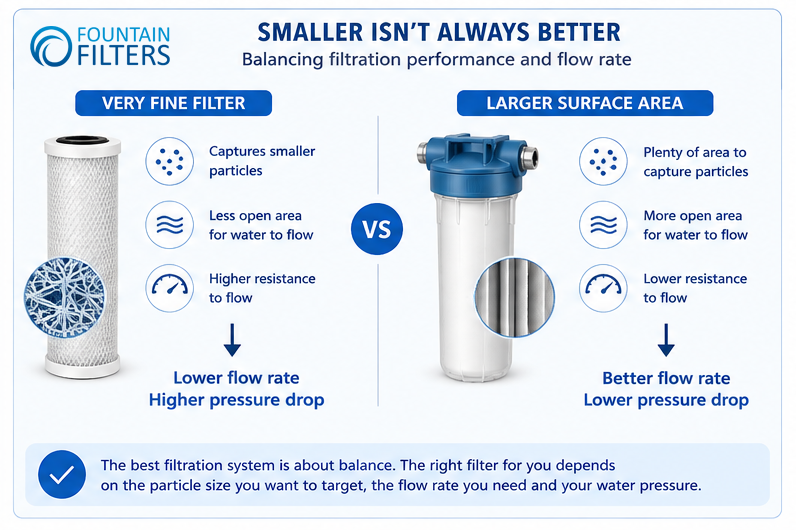
This is one of the points we think is often missed in articles about microplastics.
It might seem logical that the best approach is simply to install the smallest micron rated filter available.
But water filtration is a balance between filtration performance, flow rate and pressure drop.
The finer the filtration medium, the greater the potential restriction to water flow. A small cartridge with a very fine filtration rating may be perfectly suitable for a drinking water tap, where the required flow rate is relatively low, but completely unsuitable for filtering the entire mains water supply to a house.
Imagine installing a very fine 0.2 micron filter cartridge directly into a high-flow mains supply without enough filter surface area.
The result could be a substantial pressure drop and disappointing flow at the taps and showers.
When it comes to whole house filtration, bigger filter housing and greater filtration surface area can be much more important than simply choosing the smallest micron number.
This is why the right solution depends on the application.
For a drinking water only system, a fine filtration stage may provide excellent particle reduction without significantly affecting the rest of the home's water supply.
For whole house filtration, the filter needs to be sized to handle the required flow rate.
What is the best water filter to remove microplastics?
There isn't one best water filter for microplastics that is right for every home.
The most appropriate system depends on:
- The size of particles you want to target
- The amount of water you need to filter
- The flow rate you require
- Your available water pressure
- Whether you want to filter drinking water only or the whole house
- What other contaminants you want to reduce
- How much space you have available
- Your budget
For drinking water, a fine sediment or membrane filtration stage can provide a physical barrier to small particles.
For example, the 2023 point of use filtration study found that the devices incorporating membrane filtration were more effective at reducing the microplastic particles used in the research than the device relying only on granular activated carbon and ion exchange.
That doesn't mean that every membrane filter will remove every microplastic particle. It means that physical filtration technology matters.
This is also why we wouldn't recommend choosing a water filter solely because it has the smallest advertised micron rating.
Activated carbon water filter
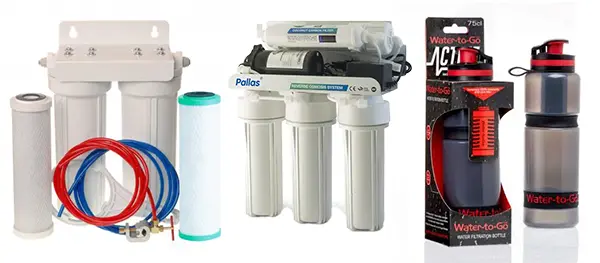
For households looking to reduce particles as well as other contaminants in drinking water, a water filter containing carbon block cartridges can combine different stages of filtration.
A suitable filter may use a carbon stage to improve taste and reduce chlorine and other contaminants, followed by a finer filtration stage designed to remove very small particles.
The advantage of a multi-stage system is that each stage can perform a different job rather than expecting one cartridge to do everything.
If you want to explore this option, we recommend our Oyster TC.
Reverse osmosis
Reverse osmosis is another option when you want a much higher level of drinking water purification.
An RO system uses a semi-permeable membrane to separate water from a wide range of dissolved substances and particulate matter.
However, reverse osmosis should not be chosen simply because you're worried about microplastics. It is a more comprehensive treatment technology and may be unnecessary if your only objective is reducing suspended particles.
If you're interested in RO, see our Reverse Osmosis Systems.
Further reading: How reverse osmosis works.
Water filter bottles
For people who need to filter water away from home, a suitable filter bottle can provide another option.
Some specialist filtration bottles are designed to reduce particles and other contaminants when travelling, hiking or using water from sources where the quality is uncertain.
The important thing is to check what the manufacturer claims the filter will remove rather than assuming that all filtered water bottles provide the same level of filtration.
FAQs
How can I remove microplastics from water?
Microplastics can be reduced using suitable physical filtration or membrane filtration. The filter needs to be capable of retaining particles of the size you want to target. A finer micron rating isn't automatically better because flow rate and pressure drop also need to be considered.
What is the best water filter for microplastics?
There isn't a single best filter for every situation. For drinking water, look for a system incorporating appropriate physical or membrane filtration and check the manufacturer's specifications and any available performance testing.
Can a 5 micron water filter remove microplastics?
A 5 micron filter can retain particles larger than its effective filtration threshold, but it should not be described as removing all microplastics. Microplastics occur across a wide range of sizes, including particles less than 5 microns.
Are there microplastics in UK tap water?
Yes. A 2025 study detected microplastics in all 177 tap water samples it tested. The average concentration was approximately 40 particles per litre, although concentrations varied considerably between samples.
Does bottled water contain more microplastics than tap water?
Not necessarily. The 2025 UK study found average concentrations of approximately 40 microplastic particles per litre in tap water and 37 particles per litre in bottled water, with no statistically significant difference between the two. Different studies using different analytical methods can produce very different particle counts.
Can boiling water remove microplastics?
Boiling can reduce some nano and microplastics under certain conditions, particularly in hard water areas where calcium carbonate forms and can trap particles. The plastic is not destroyed, however, and the research involved specific experimental conditions.
Does reverse osmosis remove microplastics?
Reverse osmosis uses a very fine semi-permeable membrane and provides a high level of physical separation. However, performance depends on the particular system and membrane, so it is best to check the manufacturer's specifications rather than assume all RO systems perform identically.
Are microplastics in drinking water harmful?
The potential health effects of microplastics are still being investigated. The WHO has identified significant gaps in the evidence and recommends further research. It would therefore be misleading to claim that the concentrations currently detected in drinking water are proven to cause specific health problems.
Need help choosing a water filter?
If you're concerned about microplastics in your drinking water, there isn't a one size fits all answer.
The right filtration system depends on the particle size you're trying to reduce, the flow rate you need and whether you're treating a single drinking water outlet or the whole house.
At Fountain Filters, we specialise in domestic water filtration and can help you compare the options.
If you're unsure which type of system is right for you, contact us and we'll help you choose a practical filtration solution based on your water pressure, flow requirements and wider water quality needs.
About the author

Louise Allen is a partner at Fountain Filters, where she's helped run the business since 2011. Alongside the day-to-day order management, despatch, and quality, she's built up a practical, hands-on knowledge of water filtration, and reviews the site's articles to keep the advice accurate and genuinely useful. Outside work, she's run the London Marathon with business partner Simon.
