

PFAS, sewage sludge, and the UK food chain: what it means for your drinking water
PFAS, sewage sludge, and the UK food chain: what it means for your drinking water
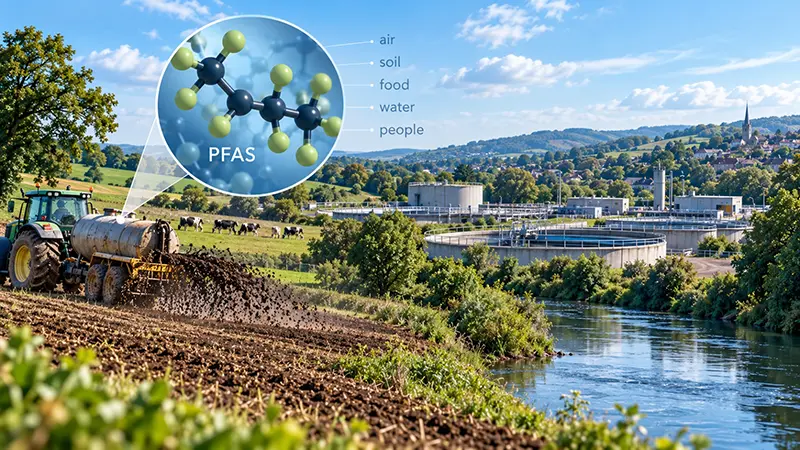
PFAS - often called 'forever chemicals' have been detected throughout the environment, including in rivers, groundwater and some of the raw water used to produce UK drinking water.
One potential route is now receiving increasing attention: treated sewage sludge spread on agricultural land.
The UK Government has confirmed that PFAS have been detected in samples of treated sludge destined for agricultural use. Research also shows that some PFAS can move from contaminated soil into crops, livestock and water.
But this does not mean food grown on treated land is automatically unsafe, or that unsafe levels of PFAS are reaching household taps.
In this guide, we look at what evidence shows about sewage sludge, the UK food chain and water. For a broader explanation of PFAS in UK drinking water, including how they are monitored and reduced see our separate guide.
Key Points
- PFAS ("forever chemicals") have been detected in treated sewage sludge spread on UK farmland, but this doesn't mean food grown there, or your tap water, is automatically unsafe.
- 94.4% of English sewage sludge is recycled onto agricultural land (covering around 1.9% of it), and while PFAS aren't part of the current statutory testing regime for sludge, Defra is consulting on reforming the regulations.
- PFAS can potentially move from contaminated soil into crops, livestock, and water, but how much depends heavily on the specific PFAS, crop, soil, and conditions involved.
- DWI testing found zero Tier 3 PFAS results (0.1 µg/L or above) in treated water supplied to consumers in England during 2024, even though PFAS were detected in some raw water sources - 96% of samples were below the detection limit.
- The Royal Society of Chemistry argues UK limits should be far stricter than the DWI's current thresholds, though its most concerning findings relate to watercourses, not treated tap water.
- Reverse osmosis, activated carbon, and PFAS-selective anion exchange are the three established filter technologies for reducing PFAS at home, but performance varies a lot by PFAS type, media, and filter design - not every "carbon" or "ion-exchange" filter is equally effective.
Table of contents
- What is sewage sludge and why is it spread on UK farmland?
- What are PFAS (forever chemicals)?
- How do PFAS end up in sewage sludge?
- Is sewage sludge tested for PFAS before being spread on UK farmland?
- From farmland to food: how PFAS move through the food chain
- What does this mean for UK tap water quality?
- Which PFAS are being found in UK water?
- Are the UK's PFAS drinking water limits strict enough?
- Can a home water filter remove PFAS from tap water?
- What is the best water filter for PFAS?
- The bigger picture: filtration treats your drinking water, not the source
- Need help choosing a water filter?
- FAQs
What is sewage sludge and why is it spread on UK farmland?
When wastewater arrives at a sewage treatment works, it undergoes a series of processes designed to separate solids from water and remove contaminants before the treated water is discharged.
The solid material left behind is known as sewage sludge. After further treatment, sludge suitable for agricultural use is often referred to as biosolids.
Rather than simply disposing of this material, most is recycled onto agricultural land.
According to DEFRA, 94.4% of sludge produced by English water and sewerage companies is reused on agricultural land, where it provides plant nutrients and organic matter. It is used on around 1.9% of UK agricultural land.
There are good reasons for doing this.
Biosolids contain useful nutrients, including nitrogen and phosphorus, as well as organic matter that can help improve soil. Recycling these nutrients can also reduce the need for some manufactured fertilisers.
The potential problem isn't the principle of recycling sewage sludge.
It is the range of substances that can enter a modern wastewater treatment works before that sludge is produced.
Wastewater doesn't only contain sewage. Treatment works can receive chemicals originating from homes, businesses, industry and waste management activities.
That includes PFAS.
Research source: Defra, Consultation on the regulatory framework for sludge applied to agriculture, 2026.
What are PFAS (forever chemicals)?
PFAS stands for per- and polyfluoroalkyl substances.
Rather than being a single chemical, PFAS describes a very large family of synthetic chemicals that have been used for decades because of their resistance to water, grease, stains and heat.
They have been used in applications including:
- Firefighting foams
- Water and stain resistant textiles
- Some food packaging
- Non-stick coatings
- Paints and coatings
- Cosmetics and personal care products
- Industrial processes
The problem is their persistence.
PFAS contain extremely strong carbon fluorine bonds. Many don't readily break down after they enter the environment, which is why they have become widely known as 'forever chemicals'.
PFAS have consequently been detected around the world in soil, wildlife and water.
But it's important not to treat PFAS as though they are all one substance.
Different PFAS can behave differently in the environment, vary in how readily they move through water and soil, and aren't necessarily associated with the same health effects.
Two of the best known and most extensively studied are PFOS (perfluorooctane sulfonate) and PFOA (perfluorooctanoic acid).
How do PFAS end up in sewage sludge?
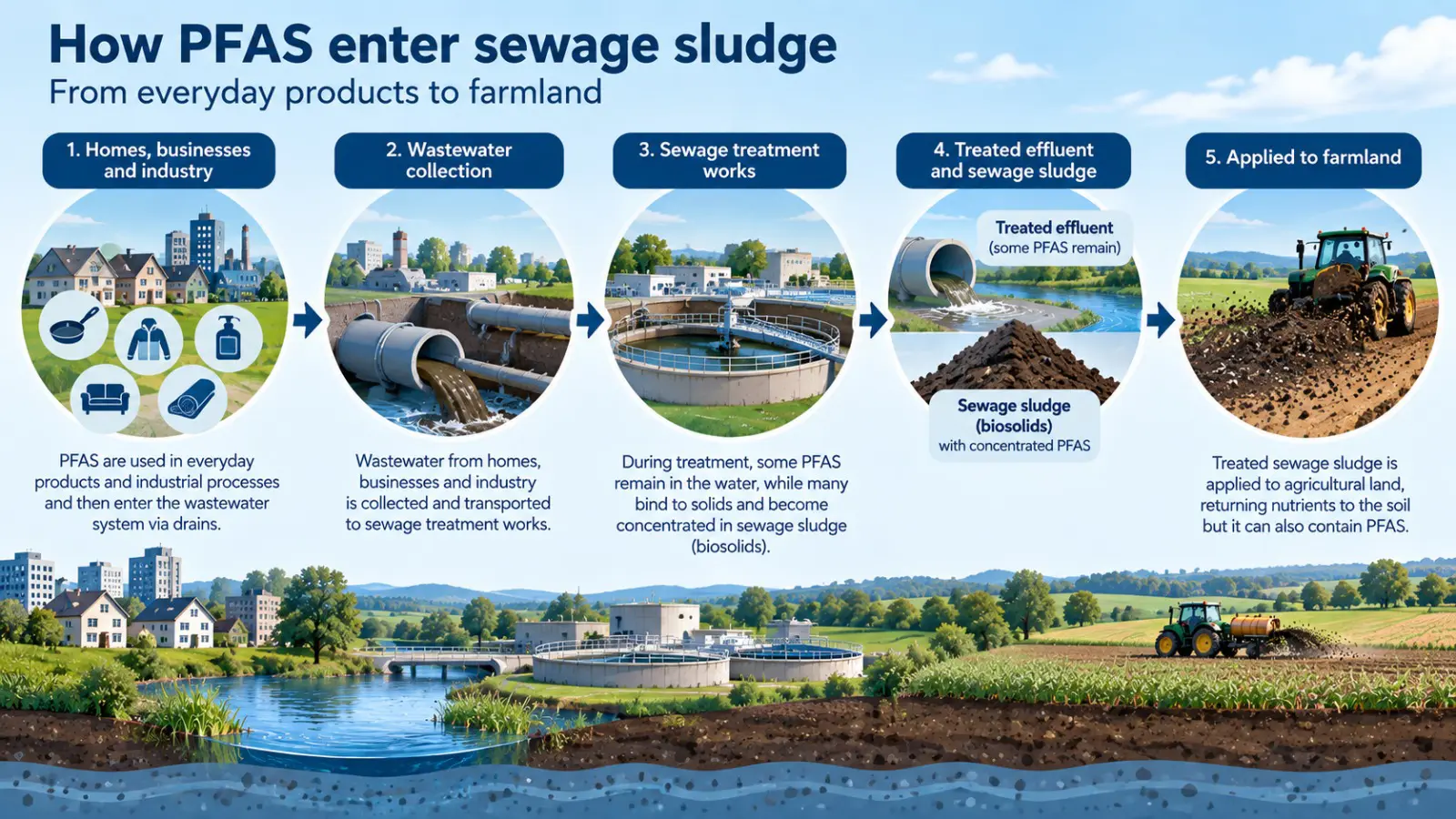
PFAS can enter the wastewater system from a variety of sources.
Everyday washing can release residues from PFAS containing products. Industrial and commercial wastewater can contain PFAS, while contaminated waste and landfill leachate provide other possible pathways into wastewater treatment.
Conventional sewage treatment wasn't originally designed specifically to destroy PFAS.
During treatment, some PFAS can remain in the liquid effluent while others can become associated with the solids separated from the wastewater.
Those solids eventually form sewage sludge.
This isn't just a theoretical pathway.
The UK Government's PFAS Plan, published in February 2026 and updated in August 2026, reports that the water industry's Chemicals Investigation Programme analysed treated sludge destined for land application from 11 sludge treatment sites in England and Wales.
The samples were analysed for substances of concern including PFOS, PFOA and PFBS.
The Government says the occurrence and concentration of PFOS and PFBS varied between samples, and further research is underway to understand what ultimately happens to these contaminants.
Separate investigative testing of sewage sludge destined for British farmland has also detected PFAS and prompted concern from environmental scientists about their potential movement into soils, crops and livestock.
So, the question is no longer simply whether PFAS can reach sewage sludge.
The more important question is what happens to them afterwards.
Research sources: UK Government, PFAS Plan: building a safer future together, 2026; CIEH Environmental Health News, forever chemicals from farm sewage sludge can enter food chain, 2025.
Is sewage sludge tested for PFAS before being spread on UK farmland?
Not as part of the established statutory sludge monitoring regime. PFAS are not currently included in the routine regulatory testing requirements for sewage sludge in the same way as potentially toxic elements such as heavy metals.
The regulations controlling sewage sludge applied to agricultural land in England date back to the Sludge (Use in Agriculture) Regulations 1989.
These rules were introduced to protect people, animals, plants and soil, but our understanding of persistent chemical pollutants has moved on considerably since then.
And the Government now accepts that the regulatory framework needs reviewing.
In 2026, Defra consulted on three possible approaches:
- Bringing sludge spreading within the Environment Permitting Regulations;
- Updating the existing sludge regulations; or
- Changing standards through non-regulatory approaches.
Defra said the aim was to improve environmental protection, safety and spreading practices.
The Government's PFAS Plan also commits to further investigation of contaminants beyond wastewater treatment sites and research into future treatment technologies that could reduce PFAS and other pollutants in sewage sludge.
Water companies are already undertaking trials, supported by the Ofwat Innovation Fund, into technologies intended to remove contaminants such as PFAS from sludge.
This doesn't mean that sewage sludge currently spread on UK farmland should automatically be regarded as unsafe.
It does mean regulators are actively investigating whether the system needs to change as our understanding of persistent contaminants improves.
Research sources: Defra, Regulatory framework reform for sludge applied to agricultural land, 2026; UK Government, PFAS Plan, 2026.
From farmland to food: how PFAS move through the food chain
Finding PFAS in sewage sludge does not automatically mean that food produced on land receiving biosolids will contain unsafe levels of PFAS.
This is an important distinction.
However, once PFAS are applied to agricultural soil, several possible pathways exist.
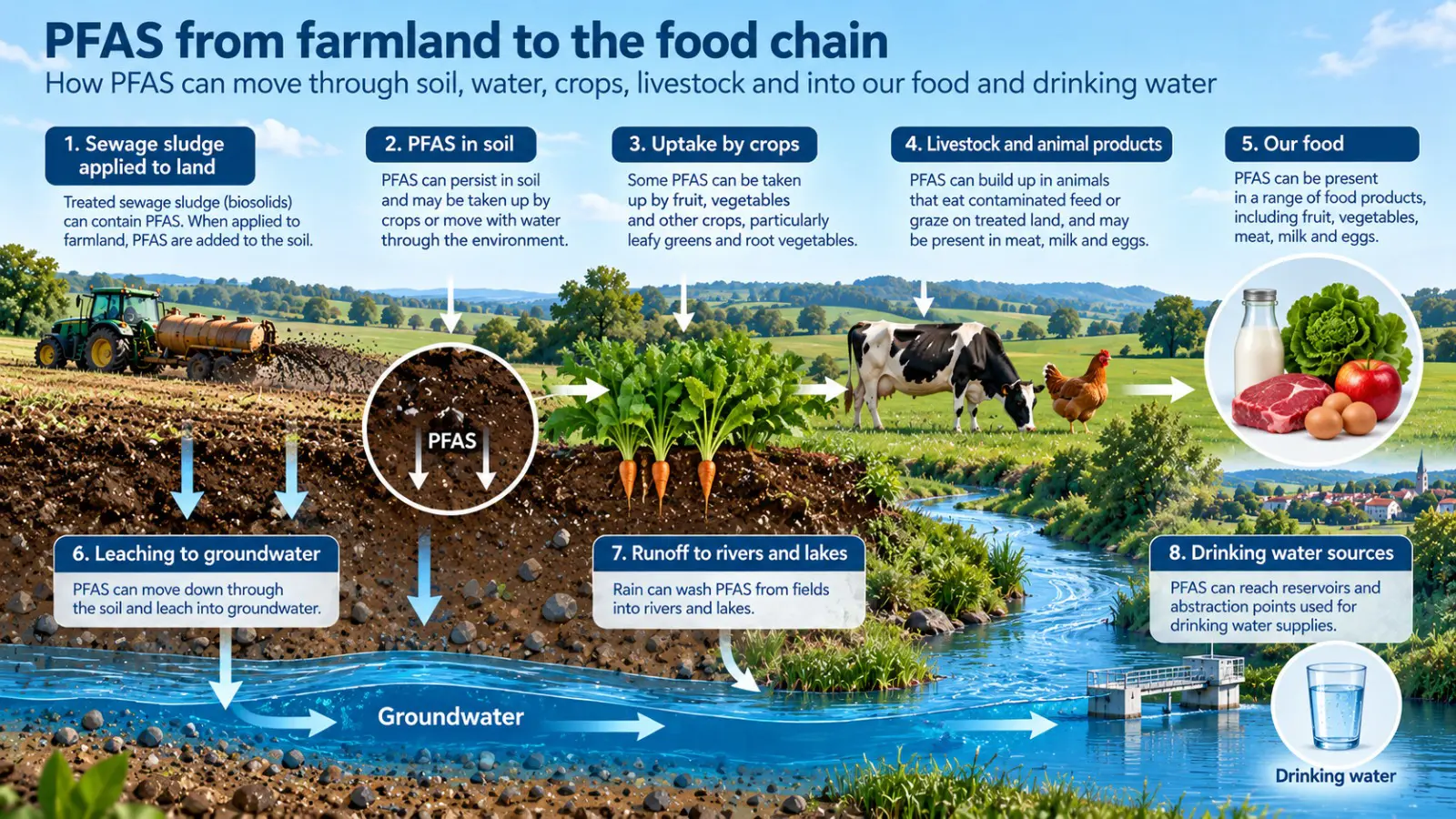
How much PFAS moves along any one of these pathways depends on the particular PFAS involved and local conditions.
PFAS can persist in soil
Persistence is the defining problem with PFAS.
Rather than rapidly degrading after entering soil, some PFAS can remain in the environment for long periods.
Repeated applications of biosolids containing PFAS could therefore provide an ongoing source to agricultural soil.
Exactly how PFAS behave once there depends on factors including their chemical structure, soil characteristics and environmental conditions.
Can crops absorb PFAS?
Yes, some PFAS can be taken up by plants.
But the extent of that uptake varies significantly between PFAS and crops.
Factors include:
- The particular PFAS
- PFAS concentration
- Crop species
- Which part of the plant is being considered
- Soil characteristics
- Availability of water
Shorter-chain PFAS are generally more mobile in water than many longer-chain compounds, which can affect how readily they move through soil and into plants.
This means statements such as "PFAS contaminated sludge makes crops unsafe" are too simplistic.
The evidence supports a potential pathway from contaminated soil into plants, but not the assumption that every crop grown on biosolids-treated land will contain harmful concentrations.
What about livestock?
Livestock provide another potential route into the food chain.
Animals can be exposed to PFAS through drinking water, soil and feed.
This is important because cattle may consume parts of crops that humans don't normally eat.
If PFAS accumulate in animal tissues or milk following sustained exposure, contamination originating in soil could potentially move further through the food chain.
Environmental scientists have raised these concerns directly. Professor Alistair Boxall of the University of York, quoted by the Chartered Institute of Environmental Health, said:
"Sludge is full of nutrients, but we need to develop ways to exploit this resource while protecting the health of the environment and consumers."
Again, this demonstrates a credible exposure pathway. It does not demonstrate that British milk or meat is generally contaminated because biosolids are used on farmland.
Can PFAS move from farmland into water?
Some PFAS can move through soil and enter groundwater, while drainage and surface runoff can transport contaminants towards streams and rivers.
This is particularly important because both groundwater and surface water are used as sources of UK drinking water.
What does this mean for UK tap water quality?
PFAS contamination of the wider environment and unsafe PFAS concentrations in household tap water are not the same thing.
This distinction is important because some coverage of PFAS combines measurements taken from rivers and groundwater with measurements from finished drinking water.
The Drinking Water Inspectorate (DWI) has substantially increased PFAS monitoring in England and Wales.
During 2024, water companies carried out more than 770,000 analyses for individual PFAS, bringing the total number of analyses conducted since 2012 to more than 1.7 million.
The DWI uses a three-tier system.
|
DWI classification |
PFAS concentration |
|
Tier 1 |
Less than 0.01 µg/L |
|
Tier 2 |
Less than 0.1 µg/L |
|
Tier 3 |
0.1 µg/L or above |
And the 2024 results provide useful context.
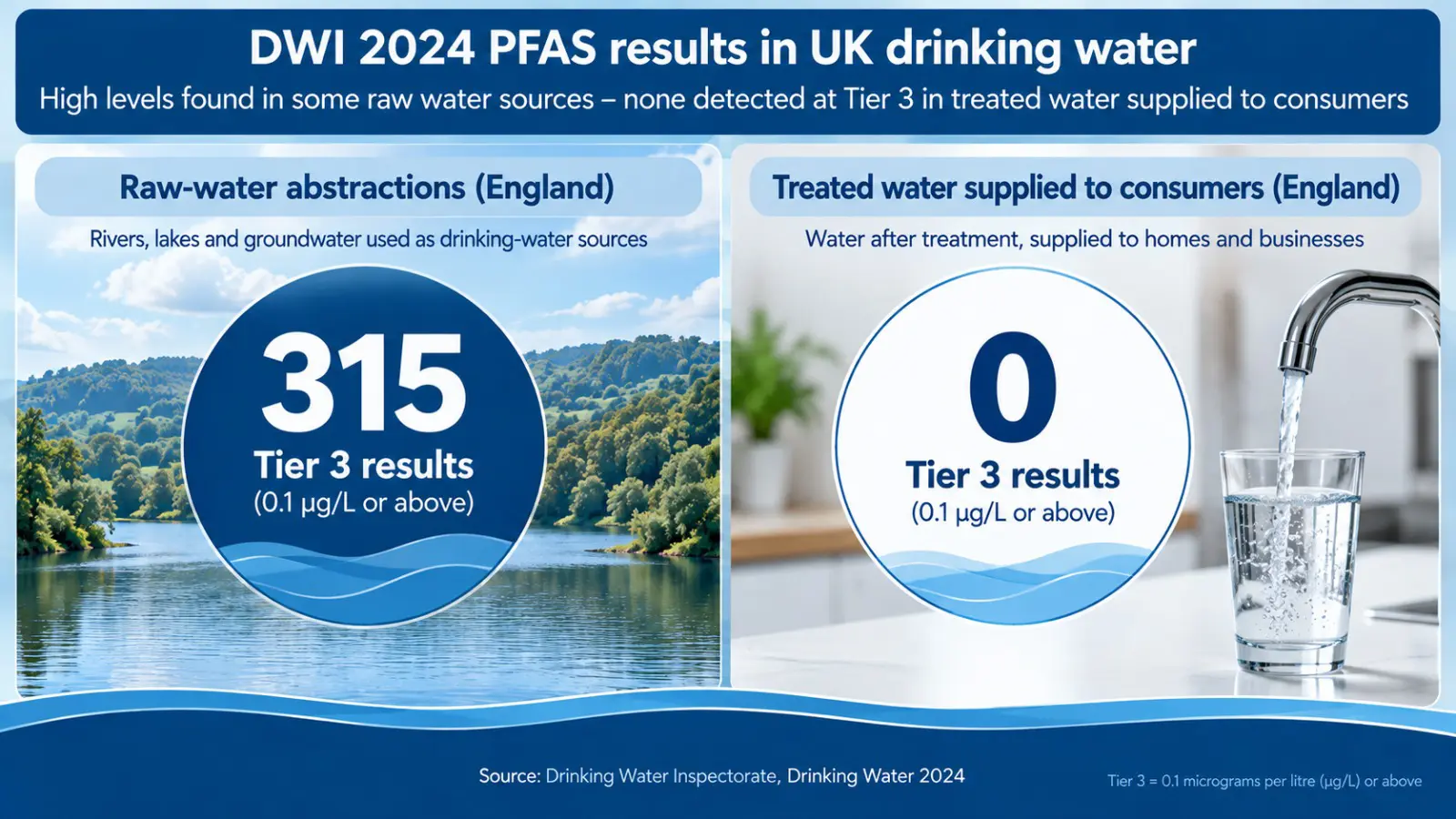
The DWI recorded 315 Tier 3 results from raw-water abstractions in England.
In contrast, it recorded 0 Tier 3 results in treated water being supplied to consumers.
The DWI also reported that 96% of samples were below the detection limit of the analytical method used.
In other words, PFAS are being detected in some of the rivers, groundwater and other raw-water sources from which drinking water is taken.
But that doesn't mean the same concentrations are reaching household taps.
Water companies can manage PFAS risks through measures including treatment, blending water from different sources or removing a source from supply.
"The current industry strategy of mitigating the risks from PFAS is working effectively to protect consumers." Drinking Water Inspectorate, Drinking Water 2024
So, this isn't evidence that UK tap water is generally unsafe.
It is evidence that PFAS contamination of the wider water environment is something water companies and regulators increasingly need to manage.
Research source: Drinking Water Inspectorate, Drinking Water 2024 - Perfluoroalkyl and polyfluoroalkyl substances (PFAS).
Which PFAS are being found in UK water?
PFAS isn't one contaminant, and the DWI's monitoring demonstrates that clearly.
In raw water during 2024, PFOS was the most prevalent PFAS, accounting for 21.1% of positive sample results.
Other PFAS detected included compounds such as:
|
Abbreviation |
Full name |
Notable for |
|
PFOS |
Perfluorooctane sulfonic acid |
Most prevalent PFAS in UK raw water in 2024 (21.1% of positive results). Legacy firefighting foams and stain repellents. |
|
PFOA |
Perfluorooctanoic acid |
One of the two most studied PFAS. Former non-stick and textile manufacturing. |
|
PFHxS |
Perfluorohexane sulfonic acid |
Used in some firefighting foams; persistent and increasingly regulated. |
|
PFHxA |
Perfluorohexanoic acid |
A short-chain replacement for older long-chain compounds; more mobile in water. |
|
PFBS |
Perfluorobutane sulfonic acid |
A short-chain replacement for PFOS; highly mobile, harder to capture on some media. |
|
PFBA |
Perfluorobutanoic acid |
Short-chain and highly mobile in water. |
|
PFPeA |
Perfluoropentanoic acid |
Short-chain carboxylic acid; mobile in water. |
|
PFHpA |
Perfluoroheptanoic acid |
Short-chain carboxylic acid; mobile in water. |
This matters when discussing water filtration.
Different PFAS have different molecular structures and treatment characteristics.
A filter performing very well against PFOS or PFOA should therefore not automatically be assumed to achieve the same reduction for every PFAS.
Research source: Drinking Water Inspectorate, Drinking Water 2024.
Are the UK's PFAS drinking water limits strict enough?
There is ongoing debate about whether the UK's current approach to PFAS in drinking water is sufficiently precautionary.
Since August 2024, DWI guidance has required water companies to consider the combined concentration of 48 named PFAS, as well as individual PFAS, and use a risk-based approach to progressively reduce concentrations.
The DWI's Tier 3 threshold is 0.1 µg/L - equivalent to 100 nanograms per litre (ng/L).
However, the Royal Society of Chemistry (RSC) has argued that the UK should go further.
It has called for:
- A limit of 10 ng/L for each individual PFAS
- A limit of 100 ng/L for PFAS combined
- Better identification and reporting of PFAS sources
- Stricter controls on industrial discharges
- Stronger national coordination of chemical regulation
The RSC's analysis found that 35% and 37% of tested watercourses in England and Wales contained what it classified as medium or high-risk concentrations of PFOS and PFOA respectively.
But those figures need context.
They refer to watercourses, not necessarily the treated drinking water coming from household taps.
That distinction is particularly important when assessing individual exposure.
The debate is therefore not simply about whether UK tap water is "safe" or "unsafe".
A bigger question is how far PFAS pollution should be allowed to build up in rivers, groundwater and the wider environment before increasingly complex treatment becomes necessary.
Research source: Drinking Water Inspectorate; Royal Society of Chemistry, Cleaning up UK drinking water.
Can a home water filter remove PFAS from tap water?
Yes. Several established water treatment technologies can substantially reduce PFAS.
However, not every filter performs equally well and a filter shouldn't be assumed to remove PFAS simply because it contains carbon or resin.
The US Environmental Protection Agency identifies three established technologies that can be effective for PFAS reduction:
- High-pressure membranes such as reverse osmosis
- Activated carbon
- Ion-exchange resin
Performance depends on factors including the type of PFAS, filter media, amount of media, water chemistry, flow rate and cartridge condition.
Reverse Osmosis filters
Reverse osmosis (RO) is one of the strongest options where broad PFAS reduction is the priority.
An RO system pushes water through a semi-permeable membrane under pressure. Water passes through while many dissolved contaminants are rejected by the membrane.
The US EPA describes high-pressure membrane technologies including reverse osmosis as extremely effective for reducing PFAS.
One advantage of reverse osmosis is that it isn't limited to PFAS.
A properly specified system can also reduce a wide range of other dissolved contaminants.
Advantages
- Very high potential PFAS reduction
- Broad spectrum contaminant reduction
- Effective against many dissolved substances
Things to consider
- Produces a wastewater stream
- Requires periodic filter and membrane replacement
- More complex than a carbon-only drinking water filter
- Performance depends on the complete system and membrane
Reverse osmosis is therefore worth considering if your priority is the highest level of broad spectrum drinking water purification, rather than targeting PFAS alone.
Research source: US Environmental Protection Agency, PFAS drinking water treatment research.
Activated carbon block filters
Activated carbon is one of the most extensively studied treatments for PFAS.
It works through a process called adsorption.
Rather than simply straining contaminants from the water, PFAS molecules become attached to the enormous internal surface area of the activated carbon as water passes through it.
Activated carbon filters can be particularly effective against longer chain PFAS such as PFOS and PFOA.
But performance varies.
Factors that matter include:
- The type of carbon
- The amount of carbon
- Contact time
- Water flow rate
- The PFAS present
- Other contaminants competing for adsorption sites
- How long the cartridge has been in use
This is why not all carbon filters should be considered equal for PFAS reduction.
A substantial carbon block through which water passes at a controlled flow rate provides very different treatment conditions from a small quantity of loose carbon in a fast flowing filter.
Shorter-chain PFAS can also be more difficult to capture and may break through activated carbon sooner than longer-chain compounds.
Advantages
- Straightforward technology
- Doesn't normally produce wastewater
- Can also reduce chlorine, tastes and odours
- Strong treatment option for some longer-chain PFAS
Things to consider
- Performance varies between different PFAS
- Carbon quantity and contact time matter
- Cartridges need replacing before contaminants break through
- PFAS reduction shouldn't be assumed without evidence for the filter
Research source: US Environmental Protection Agency, activated carbon treatment research for PFAS.
Anion exchange filters
Specialist anion-exchange resins can also be highly effective at capturing PFAS.
The resin contains sites that attract negatively charged PFAS and hold them within the filter media.
The US EPA identifies PFAS-selective anion exchange as an established PFAS treatment technology.
But there is an important distinction for domestic water treatment.
An ordinary water softener shouldn't be assumed to remove PFAS.
Traditional domestic softeners generally use cation-exchange resin designed primarily to remove hardness minerals such as calcium and magnesium.
PFAS treatment instead requires an appropriately selection anion-exchange media.
So, the fact that a water treatment system contains "ion-exchange resin" doesn't by itself demonstrate that it is suitable for PFAS.
Advantages
- Can provide highly effective targeted PFAS reduction
- Specialist resins can capture a range of PFAS
- Doesn't normally produce a wastewater stream
- Can be a useful option where PFAS reduction is the specific priority
Things to consider
- Requires a specialist anion-exchange media designed for PFAS reduction
- Ordinary water-softening resin should not be assumed to reduce PFAS
- Performance depends on the type of PFAS and the resin used
- Media requires replacement once its treatment capacity is exhausted
- PFAS reduction shouldn't be assumed without evidence for the particular filter
Research source: US Environmental Protection Agency, PFAS treatment technologies.
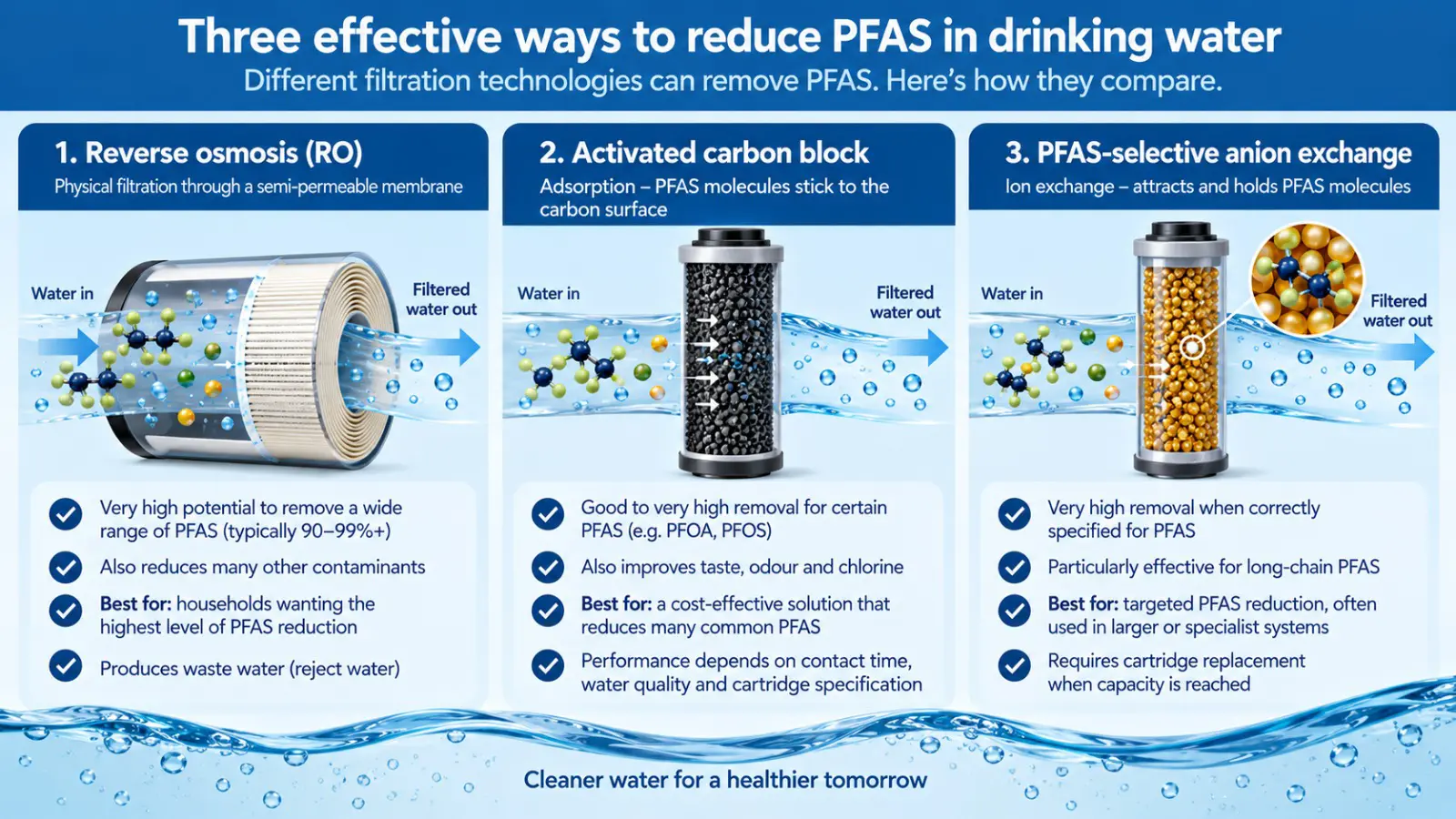
What is the best water filter for PFAS?
There isn't one best PFAS filter for every household.
It depends on the level of treatment you want and what else you want your filter to reduce.
|
Filter Type |
Potential PFAS reduction |
Best for |
Important considerations |
|
Reverse Osmosis |
Very high |
Broad-spectrum drinking water purification |
Strong option across a wide range of PFAS; produces wastewater and requires membrane maintenance |
|
Activated carbon block |
Good to very high for certain PFAS |
Straightforward under-sink drinking water filtration |
Particularly useful for many longer-chain PFAS; performance depends on carbon quantity, contact time, flow and cartridge condition |
|
PFAS-selective anion exchange |
Very high when correctly specified |
Targeted PFAS reduction |
Requires specialist media; conventional water-softening resin is not equivalent |
If your priority is broad PFAS reduction alongside a wide range of other dissolved contaminants, reverse osmosis is generally the most comprehensive of these three treatment approaches.
If you want a simpler under-sink drinking water filter without a wastewater stream, a substantial activated carbon block may be a practical alternative, particularly for longer-chain PFAS such as PFOS and PFOA.
Specialist anion-exchange media can also provide highly effective targeted PFAS reduction.
The important point is to avoid assuming that every filter labelled "carbon", "RO" or "ion-exchange" will achieve the same result.
Filter design, media quantity, contact time and maintenance all matter.
And unless a particular system has been independently tested for PFAS reduction, we would avoid attaching a precise percentage-removal claim to it.
The bigger picture: filtration treats your drinking water, not the source
Home water filtration can provide an additional barrier for people who want to reduce the amount of PFAS in their drinking water.
But it doesn't solve the underlying environmental problem.
Most established filtration technologies separate or capture PFAS rather than destroying them.
Activated carbon holds PFAS within the carbon.
Ion-exchange media retains PFAS on the resin.
Reverse osmosis separates PFAS from the purified water and transfers much of it into the reject-water stream.
Ultimately, the more effective long-term solution is preventing unnecessary PFAS from entering the environment in the first place.
The UK Government's 2026 PFAS Plan recognises this challenge. Its approach includes understanding PFAS sources, tackling pathways into the environment and reducing ongoing exposure.
The Government is also continuing research into what happens to contaminants after wastewater treatment and exploring technologies capable of reducing PFAS in sewage sludge.
This matters because PFAS contamination isn't simply a drinking water issue.
It's a whole environmental cycle:
Products and industry → wastewater → treatment works → sludge and effluent → soil and water → food and drinking water sources
Once highly persistent chemicals enter that cycle, removing them becomes considerably more difficult.
Need help choosing a water filter?
If you're concerned about PFAS in your drinking water, there isn't a one size fits all solution.
The right filtration system depends on how extensively you want to treat your water, which other contaminants you want to reduce, your available water pressure and whether you want straightforward carbon filtration or broader purification through reverse osmosis.
At Fountain Filters, we specialise in domestic water filtration and can help you compare the options without recommending more filtration than you need.
If you're unsure which type of system is right for you, contact us and we'll help you choose a practical solution for your home.
FAQs
Are PFAS present in UK tap water?
Yes. PFAS have been detected in some raw water sources and at low concentrations in some treated drinking water. In England in 2024, however, the DWI recorded no Tier 3 PFAS results (0.1 µg/L or above) in treated water supplied to consumers.
Does sewage sludge spread on UK farmland contain PFAS?
PFAS have been detected in treated sewage sludge destined for agricultural use. The UK Government's PFAS Plan confirms that PFOS and PFBS were found at varying occurrences and concentrations in samples examined through the Chemicals Investigation Programme.
Can PFAS in sewage sludge get into food?
Potentially. Research shows that some PFAS can move from contaminated soil into plants, while livestock can be exposed through feed, soil and water. The amount transferred depends on the PFAS, crop, soil and other environmental conditions, so this does not mean food produced on biosolids-treated land is automatically unsafe.
Can PFAS from farmland get into drinking water?
Potentially. Some PFAS can migrate through soil into groundwater or reach rivers through drainage and runoff. Water companies monitor raw-water sources and can use treatment, blending or other measures to prevent elevated PFAS concentrations reaching consumers.
What is the best home water filter for PFAS?
Reverse osmosis is one of the most comprehensive established options for broad PFAS reduction and can also reduce a wide range of other dissolved contaminants. Activated carbon and specialist anion-exchange systems can also be effective, although performance varies according to the PFAS and the design, media and condition of the filter.
About the author

Louise Allen is a partner at Fountain Filters, where she's helped run the business since 2011. Alongside the day-to-day order management, despatch, and quality, she's built up a practical, hands-on knowledge of water filtration, and reviews the site's articles to keep the advice accurate and genuinely useful. Outside work, she's run the London Marathon with business partner Simon.
